
Secondary Programme in India Open School Admission
Open School Admission
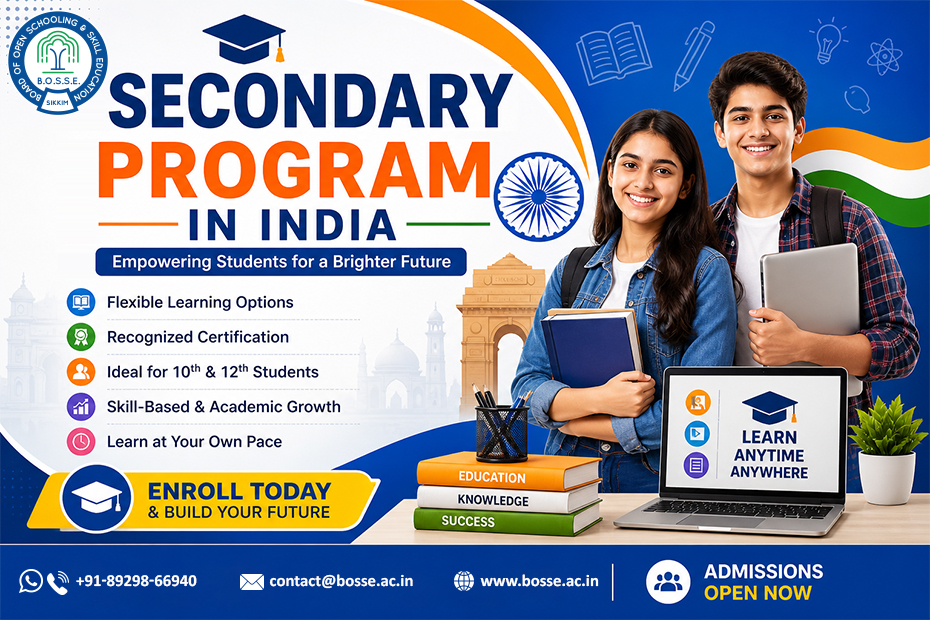
In a nation as vast and varied as India, there needs to be changes in the education systems that need to take into account the learners’ unique qualities and needs. Where the traditional form of schooling has always been considered a norm, another format of learning is fast making waves. The secondary program is a unique academic course specially designed for learners who find it difficult to go through the normal schooling system.
The Board of Open Schooling and Skill Education (BOSSE) takes center stage in this field as they provide unique forms of academic learning. This blog will take into account the importance, format, strengths, and significance of the Secondary Programme in India, especially open schooling and open school admissions.
Understanding the Secondary Programme in India
Secondary education means education in the secondary stage, which usually corresponds to class 10. Secondary education is an important milestone in education, providing basic knowledge, reasoning skills, and life skills required for future education and professional careers.
Generally, learners join secondary education in mainstream institutions that have affiliation with CBSE, ICSE, or other state boards. But all learners cannot study in mainstream institutions because of some limitations in their lives, such as economic, geographical, social, or personal reasons. Open school education opens up new opportunities for such students.
What is Open School Education?
Open school education refers to an adaptable form of education whereby learners have flexibility in terms of studying at their own pace, selecting subjects based on personal interest, and appearing for tests when ready. Unlike traditional forms of education, open schooling does away with the hurdles associated with age, location, and time.
Based on the reports released by various institutions of learning and policies such as NEP 2020, the adoption of flexible learning models like open schooling is necessary to improve GER and reduce the dropout rate in India.
According to UNESCO, flexible learning models like open and distance learning have a great chance to bridge the learning gap that exists among many out-of-school kids and youths. Therefore, secondary education through open schooling becomes indispensable in modern-day India.
Role of BOSSE in Open Schooling
BOSSE stands for the Board of Open Schooling & Skill Education, and it is committed to offering quality education by adopting open schooling approaches. BOSSE provides a structured secondary curriculum that conforms to national education standards yet remains flexible.
The board focuses on:
- Inclusive education for all learners.
- Skill-based and vocational integration.
- Affordable learning opportunities.
- Digital and self-paced learning support.
Online Courses and Academic Programs
To enhance the learning process, BOSSE provides well-designed online courses and intensive crash courses specifically for secondary program learners. These programs focus on core academic subjects and help students strengthen their understanding, improve performance, and succeed within the open schooling system.
Key Features:
- Online live interactive classes offered by expert faculty members for the learners.
- Classes are scheduled twice annually:
- From February to March.
- From September to October.
- Study materials and assignments are made available to the learners digitally.
- Facility for learning from home, making it convenient for the learners.
BOSSE has designed its open school education model to empower learners from all walks of life—students, working professionals, homemakers, and even those who had to discontinue their education earlier.
Open School Admission: A Flexible Gateway
One of the most attractive features of BOSSE is its simple and inclusive open school admission process. Unlike traditional schools that have strict deadlines, eligibility constraints, and limited seats, BOSSE offers year-round admission opportunities.
Key Highlights of Open School Admission:
- No Age Barrier: Learners of any age can enroll in the secondary program.
- Flexible Entry: Students can apply anytime during the year.
- Minimal Documentation: Easy and hassle-free application process.
- Choice of Subjects: Students can select subjects based on their interests and career goals.
This flexibility ensures that education is not restricted by circumstances but driven by aspiration.
Why Choose the Secondary Programme Through Open Schooling?
- Learning Flexibility
One of the major benefits of open schooling is the flexibility provided by open schooling for learning. Students can manage their education alongside their employment and other duties.
- Personalized Learning
The Secondary Programme of open school education does not involve classroom learning, unlike conventional learning. Hence, students have the opportunity to concentrate on what they like, resulting in good performance in academics.
- Dropout Prevention
Research shows that flexible learning programs decrease dropout rates considerably. Students leaving their studies due to various reasons get a chance to pursue their education in open schools.
- Skill Integration in Learning
The BOSSE curriculum includes vocational as well as skill-based subjects, guaranteeing that students learn both theoretical knowledge and practical skills.
- Accessible Education for All
Open education can reach students anywhere from rural regions to urban centers. Moreover, digital learning tools make it easy for students to access educational material.
Structure of the BOSSE Secondary Programme
The Secondary Programme offered by BOSSE is designed to provide a balanced academic experience. It typically includes:
- Core Subjects: Languages, Mathematics, Science, and Social Studies.
- Elective Subjects: Based on student interest.
- Skill-Based Courses: Vocational training and practical learning.
Students are assessed through a combination of assignments, practical work, and examinations, ensuring a comprehensive evaluation system.
Impact of Open School Education in India
The rise of open school education has brought significant changes in the Indian education landscape.
Statistical Insights:
- According to government data, millions of students drop out before completing secondary education each year.
- Open schooling systems have helped re-enroll a significant percentage of these learners.
- The flexibility of open schooling has contributed to increased literacy rates and improved access to education.
Psychological studies also suggest that flexible learning environments reduce stress and anxiety among students, leading to better mental health and academic outcomes.
Who Should Opt for the Secondary Programme in Open Schooling?
The secondary program under BOSSE is ideal for:
- Students who have discontinued formal education.
- Working professionals seeking to complete their schooling.
- Individuals preparing for competitive exams.
- Learners from remote or underserved areas.
- Students who prefer self-paced learning.
Career Opportunities After a Secondary Program
Completing the secondary program opens multiple pathways for students:
- Higher Secondary Education (Class 12).
- Diploma and vocational courses.
- Skill-based training programs.
- Entry-level job opportunities.
With the integration of skills and academics, students from open school education backgrounds are increasingly being recognized by employers and institutions.
Challenges and the Way Forward
While open schooling offers numerous benefits, it also comes with certain challenges:
- Lack of awareness among students and parents.
- Misconceptions about the credibility of open school education.
- Need for better digital infrastructure in rural areas.
However, with increasing government support, policy reforms, and initiatives by boards like BOSSE, these challenges are gradually being addressed.
Conclusion
The secondary education program in India has come up as a great step for promoting inclusive and flexible learning. The open school education will ensure that learners are not denied opportunities just because of rigid frameworks and their own personal reasons.
With its student-oriented approach, easy-to-access open school admission process, and emphasis on skill learning, BOSSE is revolutionizing the concept of education in India. Open schooling will be instrumental in shaping the future of India, which aims at becoming an inclusive knowledge society.
In today’s world, education is all about finding the right fit for you. Not only have you got the opportunity to find that perfect fit, but the secondary program through open schooling will make sure of it.
FAQs
- What is the Secondary Programme in open schooling?
The Secondary Programme is a class equivalent to Class 10 that enables learners to finish their secondary education through an innovative learning process.
- Who can enroll in open schools?
Any person willing to further or resume his/her studies can enroll in open schools without any age criteria.
- Is open schooling recognized in India?
Yes, education acquired from open schools such as BOSSE is recognized for higher education as well as employment.
- Am I able to study from home in the secondary program?
Yes, you are allowed to study from home through the availability of study materials and online classes.
- Are online classes provided to secondary program learners?
Yes, online classes and crash courses are offered to secondary program learners at BOSSE.