
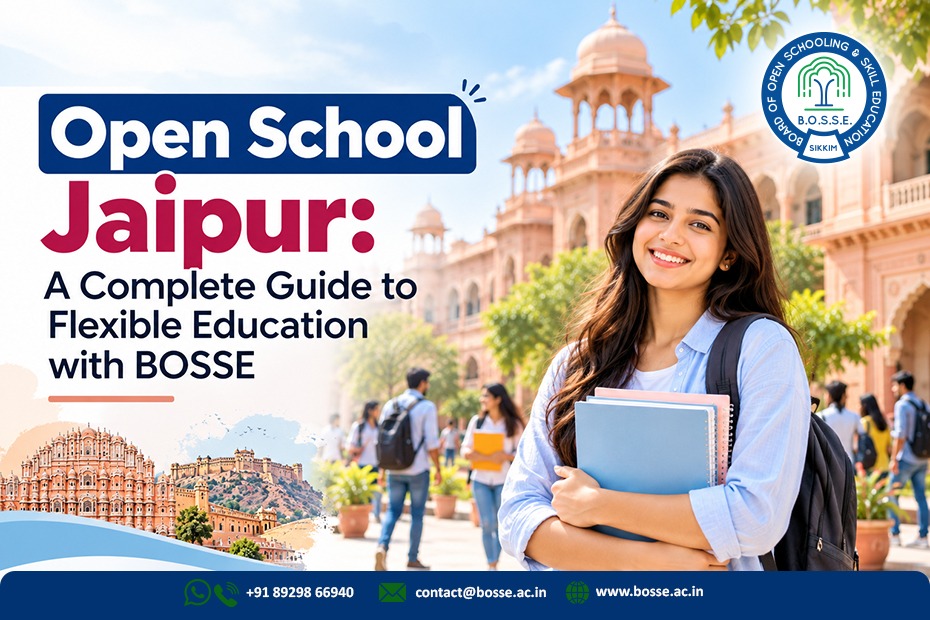
Open School Jaipur: A Complete Guide to Flexible Education with BOSSE
Education creates opportunities, builds confidence, and prepares you for a better future. However, every student has a different learning journey. Some students want to continue their education while working, some need another opportunity after struggling with regular school examinations, and others require a flexible learning system that fits their personal responsibilities. If you live in Jaipur or another part of Rajasthan and want to complete your school education, open schooling can provide an alternative pathway.
Choosing an open school in Jaipur can help you work towards your academic goals without following the same daily classroom routine as a traditional school. Whether you want to complete Class 10, pursue Class 12, or prepare for further studies, understanding your options is the first step towards making an informed decision.
At the Board of Open Schooling and Skill Education (BOSSE), we recognize that students have different educational needs and circumstances. Our approach to open schooling focuses on providing opportunities for learners who want to continue their education through a flexible academic pathway.
If you are searching for open school Rajasthan options, exploring open school admission, or comparing an open board with traditional schooling, this guide will help you understand the process, benefits, eligibility considerations, and future opportunities associated with open education.
10th Open School Admission
Completing Class 10 is an important milestone in your educational journey. It establishes the foundation for senior secondary education, vocational learning, and several future career pathways. However, not every student can complete secondary education through a regular school.
You might have discontinued your studies because of financial responsibilities, family circumstances, relocation, health-related challenges, sports commitments, or difficulties adjusting to a traditional classroom environment. Whatever your circumstances, continuing your education can help you reopen opportunities that may otherwise appear difficult to access.
With 10th open school admission, you can explore a flexible way to work towards completing your secondary education. Open schooling is particularly useful for learners who need greater control over their study schedules and want to balance education with other responsibilities.
What Is Open Schooling for Class 10?
Open schooling is an educational system that provides an alternative to conventional, full-time classroom-based schooling. Depending on the board’s rules and the programme you choose, it may offer flexible study arrangements, subject choices, and examination opportunities.
Instead of attending a regular school throughout the day, you can organise your preparation around your individual circumstances. You still need to study the prescribed subjects, meet the applicable eligibility requirements, complete assessments, and appear for examinations according to the board’s regulations.
The purpose of open schooling is not to make education less important. It is to make educational opportunities accessible to learners who need a different way to pursue them.
For example, imagine that you left school after Class 8 because your family relocated. Returning to a regular school may be difficult because of your age, responsibilities, or circumstances. An appropriate open schooling programme could provide another route towards completing secondary education.
Similarly, if you are interested in sports, music, performing arts, or another demanding activity, a flexible study schedule may help you manage your academic preparation alongside your other commitments.
Who Should Consider 10th Open School Admission?
Open schooling can be worth exploring if you identify with any of the following situations:
- Students who discontinued regular schooling and want to continue their education.
- Learners who need another opportunity to complete secondary education.
- Working individuals who want to obtain a school-level qualification.
- Students who require greater flexibility because of family responsibilities.
- Learners involved in sports, arts, or other activities that demand substantial time.
- Individuals who want to strengthen their academic foundation before pursuing further education.
- Students who prefer independent study and can follow a structured preparation schedule.
Your eligibility will depend on the specific programme and the board’s admission requirements. Before applying, review the applicable age criteria, previous educational qualifications, documentation requirements, and examination rules.
Why Is Class 10 Important for Your Future?
Class 10 provides a foundation for further academic and professional development. Completing secondary education can help you meet the basic educational requirements for senior secondary programmes, subject to the relevant board’s rules.
After completing Class 10, you can explore senior secondary education in streams or subject combinations that align with your interests and future plans. Depending on the subjects selected, subsequent opportunities may include higher education, vocational programmes, technical training, and entry-level employment where the qualification requirements are met.
For example, a student interested in business may want to study commerce-related subjects at the senior secondary level. Someone interested in engineering may need to plan for mathematics and science subjects. A learner interested in humanities may explore subjects that support future studies in social sciences, languages, or related disciplines.
Your choice of subjects should reflect both your interests and the eligibility criteria of the courses you may wish to pursue later.
The key is to treat Class 10 as the beginning of your next educational stage, rather than simply an examination you need to pass.
Open School Rajasthan: Understanding Your Educational Options
Rajasthan has students from diverse educational, social, and economic backgrounds. While many learners follow the traditional school system, others require alternative arrangements that allow them to continue their studies.
If you are searching for open school Rajasthan options, you should first understand how open schooling works and what you need from an educational board.
Jaipur, being a major educational centre, attracts students preparing for school examinations, entrance tests, competitive examinations, and professional careers. Nevertheless, not every learner can attend regular classes daily. An open schooling programme may provide an alternative for eligible students who need a different learning arrangement.
Why Do Students Look for Open Schooling in Rajasthan?
Students explore open schooling for several reasons.
- Flexible learning arrangements
Some learners cannot follow a fixed school timetable because of work, family responsibilities, travel, or other commitments. Open schooling can help them organise their preparation around their circumstances, subject to the board’s academic and examination requirements.
- An opportunity to continue education
Students who have discontinued their studies may want to return to education without repeating the same routine that previously proved difficult to manage. Open schooling offers an alternative route worth considering.
- Support for independent learners
Some students are comfortable studying independently with textbooks, learning materials, written notes, and planned revision sessions. For these learners, a structured self-study routine can be an effective part of exam preparation.
- The ability to balance different priorities
Students involved in sports, arts, family businesses, or employment may need a learning arrangement that accommodates their schedules. Open schooling can help eligible learners work towards their qualifications while managing these responsibilities.
- Greater control over study time
You can divide your preparation into manageable sessions, spend more time on challenging subjects, and revise topics according to your progress.
However, flexibility does not eliminate the need for discipline. You must still complete the syllabus, prepare for examinations, and meet the board’s requirements.
What Does the Data Say About the Need for Flexible Education?
Official education statistics help explain why alternative learning pathways matter.
According to India’s UDISE+ 2023–24 data cited in a Lok Sabha response, Rajasthan recorded a secondary-level school dropout rate of 9.4%. The reported rates were 7.1% at the primary level and 6.8% at the upper-primary level. These figures describe different stages of schooling and should not be treated as measurements of the number of students who need open schooling. However, they highlight the importance of educational continuity and opportunities for learners who face difficulties completing school through conventional arrangements.
A separate Ministry of Education parliamentary document reports an all-India secondary-level dropout rate of 11.5% for 2024–25. This figure is based on a different reporting year and should not be directly compared with Rajasthan’s 2023–24 rate as if both represented the same period. Nevertheless, the data reinforces the importance of keeping learners connected to education.
These statistics do not mean that open schooling is the right solution for every student. They demonstrate why educational systems need to account for learners with different circumstances.
For you, the practical question is simple: if a regular school arrangement does not suit your needs, what legitimate educational options can help you continue studying?
Exploring open schooling, understanding the available programmes, and checking the recognition and eligibility requirements can help you make a more informed decision.
Can You Choose BOSSE If You Live in Jaipur?
Yes, you can explore BOSSE’s programmes while living in Jaipur, provided you meet the applicable eligibility requirements and follow the board’s admission procedures.
The Board of Open Schooling and Skill Education is based in Sikkim and offers secondary, senior secondary, and vocational education programmes. Its official website provides information about programmes, admissions, and the board’s recognition and approval documentation.
You should distinguish between the location where you live and the board that awards your qualification. Searching for an open school in Jaipur does not necessarily mean that the educational board must be based in Jaipur.
However, before enrolling, you should confirm the applicable examination arrangements, subject availability, document requirements, and any location-specific instructions directly through official BOSSE channels.
This approach helps you understand the programme before making a decision about your education.
What Is an Open Board and How Does It Work?
An open board is an educational board that provides recognised educational programmes through an open schooling or alternative learning framework, subject to its applicable rules and recognition.
Unlike a conventional school that generally requires regular classroom attendance, open schooling programmes may provide greater flexibility in how students organise their learning. The precise arrangements depend on the board and the programme.
If you are considering an open board for Class 10 or Class 12, you should understand four essential elements.
- Admission and Registration
You must complete the relevant registration process and provide the documents required for your chosen programme. Depending on the programme, these may include proof of identity, date of birth, previous educational records, photographs, and other supporting documents.
The board determines the applicable eligibility conditions and documentation requirements.
- Subject Selection
Your subjects influence what you study and may affect your future academic options.
For example, a student planning to pursue a science-related course after Class 10 should consider the subject requirements of the intended senior secondary programme and the eligibility rules of the future course.
Similarly, a learner interested in business or humanities should select subjects that align with their academic goals.
You should not choose subjects solely because they appear easy. Consider your strengths, interests, preparation time, and long-term plans.
- Independent Study and Preparation
Open schooling requires you to take responsibility for your learning.
You may need to study textbooks, prepare notes, practise questions, complete assignments where applicable, and revise regularly. Your preparation schedule should account for every subject rather than focusing exclusively on the topics you find interesting.
A weekly timetable can make this process easier. Allocate additional time to difficult subjects, set realistic daily targets, and use regular revision to reinforce what you have learned.
- Examinations and Certification
You must meet the board’s examination and assessment requirements to complete the programme.
The relevant examination schedule, assessment structure, passing requirements, and certificate conditions depend on the programme and applicable board rules.
Before enrolling, review these requirements so that you understand what is expected throughout your academic journey.
Open School Admission: Eligibility, Documents and Application Process
If you want to apply for an open schooling programme, understanding the admission process can help you prepare the necessary information in advance.
BOSSE provides an online admission facility through its official website. Its published admission information describes registration for secondary, senior secondary, skill, and vocational programmes. Applicants are required to submit the documents specified during registration.
Although the broad process is straightforward, you should carefully follow the current instructions for your chosen programme.
Step 1: Choose Your Programme
First, decide whether you want to pursue secondary education equivalent to Class 10, senior secondary education equivalent to Class 12, or a suitable vocational programme.
Your choice should reflect your current educational qualification and future goals.
If you have not completed Class 10, begin by exploring the relevant secondary programme. If you have already completed Class 10, investigate the senior secondary programme and its eligibility conditions.
Step 2: Review Eligibility Requirements
Check the minimum educational qualification, age criteria, subject requirements, and other conditions applicable to your programme.
Do not assume that eligibility rules are identical across all open boards or educational levels.
If you previously enrolled in another board, have incomplete academic records, or want to transfer credits, carefully review the applicable rules before proceeding.
Step 3: Understand the Admission Schedule
BOSSE’s published website information describes two admission blocks:
- Block 1: 1 March to 31 August, with examinations in April–May of the following year.
- Block 2: 1 September to the end of February, with examinations in October–November of the same year.
These are the schedules displayed in the cited admission information. You should check the current official admission notice for the applicable academic session, examination arrangements, and any changes before submitting an application.
Understanding the schedule helps you plan your studies and estimate how much preparation time you may have before the relevant examination period.
Step 4: Complete the Application Form
Visit the official BOSSE website and locate the admission section for your chosen programme.
Enter the requested personal and academic details accurately. Your name, date of birth, previous educational information, and other details should match your supporting documents.
Review the form before submission to reduce the possibility of errors.
Step 5: Upload the Required Documents
Prepare the documents specified in the official application instructions.
Depending on your circumstances and programme, you may need identity documents, photographs, date-of-birth proof, previous marksheets, certificates, or other records.
Ensure that the uploaded files are readable and comply with the prescribed format and size requirements.
Step 6: Complete the Applicable Fee Payment
Review the current fee structure and payment instructions for your programme.
The amount payable may depend on the programme, subjects, applicable fees, and other requirements specified by the board. Use the official payment facility and retain the payment receipt and application confirmation for your records.
Avoid relying on unofficial fee quotations or making payments to unauthorised individuals.
Step 7: Follow Your Academic Schedule
After completing registration, keep track of the information and instructions issued for your programme.
Organise your study materials, create a revision timetable, and monitor examination-related announcements.
If any details need correction or additional documentation is required, follow the board’s official instructions.
For accurate admission information, visit the official BOSSE website.
Why Choose BOSSE for Open Schooling?
Choosing an educational board is an important decision because it influences your academic preparation, examination arrangements, and future educational planning.
At BOSSE, we recognise that students need educational opportunities that account for their individual circumstances. Our secondary, senior secondary, and vocational programmes provide options for learners who want to pursue academic or skill-oriented education through the board’s prescribed framework.
Here are several reasons you may consider BOSSE while exploring an open board.
- Opportunities for Secondary and Senior Secondary Education
We offer secondary and senior secondary programmes for learners exploring school-level educational qualifications.
If you want to complete Class 10, you can investigate the secondary programme and its admission requirements. If you have already completed secondary education, you can explore the senior secondary programme and the subjects available under the applicable rules.
This structure helps you plan your education according to your current qualification and future objectives.
- Flexible Learning for Different Circumstances
We understand that not every student can follow a traditional classroom schedule. You may be managing a job, helping with a family business, pursuing sports, or dealing with responsibilities that make regular school attendance difficult. An open schooling arrangement may help you organise your studies around these circumstances.
You remain responsible for preparing for examinations and meeting academic requirements, but the learning arrangement can provide greater flexibility than conventional full-time schooling.
- Subject Choices That Support Your Academic Goals
Your educational interests may change as you discover new subjects and career possibilities. BOSSE describes its secondary and senior secondary programmes as offering flexibility in subject choice and combinations, subject to programme rules. This can help you investigate academic pathways that align with your interests and future plans.
Before selecting subjects, consider the requirements of the courses you may want to pursue after Class 10 or Class 12.
For example, some undergraduate programmes require particular subjects or minimum marks at the senior secondary level. Planning ahead can help you avoid choosing a combination that does not meet your intended course’s eligibility criteria.
- An Online Admission Facility
We provide online admission information and registration facilities through the official BOSSE website. For students in Jaipur and other parts of Rajasthan, online registration can make it easier to begin the application process without initially travelling to the board’s home state.
You can review the programme information, prepare your documents, and follow the prescribed application procedure.
Online registration does not automatically mean that every stage of the programme or examination can be completed remotely. Always check the applicable examination and assessment arrangements.
- Vocational Education Opportunities
Academic qualifications and practical skills can complement each other. Alongside secondary and senior secondary education, BOSSE lists vocational programmes intended to support skill-oriented learning. The specific courses available, their duration, and their requirements should be checked through the official programme information.
Vocational education may be useful if you want to explore practical learning alongside your broader educational goals.
For example, you might be interested in developing employment-related skills while planning your next academic step. The right programme will depend on your interests, eligibility, and intended career direction.
- Published Recognition and Equivalence Information
Recognition is one of the most important factors to consider when selecting an open board. BOSSE publishes recognition and approval information on its official website, including documentation relating to educational equivalence and recognition by various institutions and organisations.
You should examine the relevant documentation rather than relying solely on general promotional claims. Recognition for one purpose does not automatically establish eligibility for every university course, professional programme, competitive examination, or recruitment process. The receiving institution or authority may impose additional conditions.
We encourage you to understand these requirements before selecting a programme, especially if you have a specific university degree, professional qualification, or government recruitment examination in mind.
- A Pathway for Students Who Want to Continue Learning
Sometimes, students assume that a break in education has permanently limited their opportunities. However, an interruption does not mean you must stop planning for the future.
Open schooling can provide an alternative route for eligible learners who want to complete their education and investigate further opportunities.
At BOSSE, our secondary, senior secondary, and vocational programme options allow you to explore different learning pathways according to your academic background and goals.
Your progress will depend on your preparation, the programme you select, and your ability to meet the applicable academic requirements. With careful planning, you can take a more organised approach to your education.
Open Schooling vs Regular Schooling: Which Is Better for You?
There is no single answer that suits every student. Regular schooling and open schooling serve different learning needs, and the right choice depends on your circumstances. Consider the following comparison.
| Factor | Regular Schooling | Open Schooling |
| Learning environment | Generally based on regular classroom attendance | Designed to provide an alternative learning arrangement |
| Daily timetable | Usually follows a fixed school schedule | May provide greater flexibility in organising study time |
| Teacher interaction | Regular face-to-face classroom interaction | The available support depends on the board and programme |
| Study responsibility | Shared between the student and the school structure | Requires substantial independent planning and preparation |
| Suitable learners | Students who can follow a conventional school routine | Students who need an alternative route or greater scheduling flexibility |
| Academic progression | Depends on completing the required school programme | Depends on completing the applicable open schooling programme |
| Examination requirements | Set by the relevant board and school system | Set by the relevant open board and programme |
The comparison is general. Individual schools and open boards may differ in the arrangements and support they provide. If you enjoy daily classroom interaction and can attend school regularly, a conventional school may suit you well. If your circumstances make regular attendance difficult, open schooling may be worth exploring.
Think about your learning habits before deciding. Can you follow a timetable without daily supervision? Are you comfortable reading textbooks independently? Can you consistently complete assignments and revise subjects? Are you prepared to ask for academic help when you need it? Your answers can help you decide whether an open schooling arrangement matches your needs.
How to Prepare for Class 10 Through an Open Board
Admission is only the beginning. To complete Class 10 successfully, you need a practical preparation strategy that helps you study consistently and measure your progress.
Here are several approaches you can use.
Create a Realistic Study Timetable
Begin by listing your subjects and the topics you need to complete. Divide the syllabus into weekly targets rather than attempting to study everything at once. Allocate more time to subjects that require additional practice, and reserve time for revision.
If you are working or managing family responsibilities, plan shorter study sessions around your existing commitments. For example, you might study for an hour in the morning and another hour in the evening. The ideal timetable is the one you can maintain consistently.
Understand Concepts Before Memorising Answers
Memorisation may help with certain definitions and factual questions, but understanding concepts makes it easier to apply what you learn.
In mathematics, practise different types of questions instead of reading solved examples alone. In science, understand the principles behind important processes. In languages, practise reading comprehension, grammar, and writing. For social science subjects, organise information using timelines, maps, short notes, and topic summaries where appropriate.
Use Previous Papers and Practice Questions
Practice questions can help you understand how topics are assessed and identify areas that need improvement.
Use previous examination papers only when they are relevant to your syllabus and examination pattern. Do not assume that an old paper guarantees what will appear in a future examination. After completing a practice paper, review your mistakes and revise the concepts behind them.
Revise Regularly
Do not wait until the final weeks to revise the syllabus. Set aside time each week to revisit earlier topics. Short revision sessions can help you identify what you remember and what requires further attention. Maintain a list of difficult concepts and review it regularly.
Monitor Your Progress
At the end of each week, check whether you have completed your planned targets. If you have fallen behind, adjust your timetable rather than abandoning it.
You can track your preparation using a simple notebook with three columns: topics completed, topics requiring revision, and topics not yet studied. This approach gives you a clearer picture of your progress and helps you prepare more systematically.
What Can You Do After Completing Class 10 Through Open Schooling?
Completing Class 10 can open the door to several educational pathways, depending on your results, subjects, eligibility, and future interests. The next step should be based on what you want to achieve rather than what others expect you to choose.
Continue to Class 12
Many students choose senior secondary education after Class 10. You can explore the subjects and streams available through the relevant board and select a combination that supports your future plans.
If you are interested in undergraduate education, investigate the eligibility criteria for your intended course before choosing subjects.
Explore Vocational Education
Vocational education focuses on developing skills relevant to particular occupational areas.
Depending on the programme, vocational learning may help you develop practical knowledge and prepare for further skill development. Check the duration, curriculum, assessment requirements, and recognition applicable to the course you select.
Develop Employment-Related Skills
You may also choose to develop additional skills alongside your academic preparation. Communication, computer literacy, digital skills, problem-solving, and time management can be valuable across many fields.
However, individual jobs have different educational and skill requirements. Completing Class 10 alone does not guarantee employment, and you should review the requirements of the occupations you want to pursue.
Plan for Higher Education
If you want to attend college in the future, plan your school education with your intended undergraduate programme in mind. Different degree programmes have different subject and minimum-mark requirements. Some professional programmes also have specific eligibility conditions established by their regulators or admission authorities.
Before selecting a senior secondary subject combination, examine the eligibility rules for your intended course and the recognition applicable to your educational board. A clear plan can help you make better academic decisions at every stage.
Common Mistakes to Avoid During Open School Admission
While exploring open schooling, students sometimes focus exclusively on completing the application form. However, the decisions you make before and after registration can also affect your educational journey.
Avoid these common mistakes.
- Choosing a board without checking recognition: Review the official recognition documentation and confirm the requirements of the institution or examination authority relevant to your future plans.
- Providing incorrect information: Enter your personal and academic details carefully. Inconsistent records can create difficulties during verification or certification.
- Selecting subjects without considering future plans: Check the eligibility requirements of the courses you may wish to pursue after Class 10 or Class 12.
- Assuming that flexible learning requires little effort: Open schooling still requires consistent study, revision, and preparation for examinations.
- Ignoring examination instructions: Keep track of the applicable examination schedule, assessment rules, and other official announcements.
- Relying on unverified admission claims: Use official board information to check fees, eligibility, programme availability, and application requirements.
- Delaying preparation until the examination approaches: Begin studying early and establish a routine that allows enough time for revision.
Avoiding these mistakes can help you approach your education with greater confidence and clarity.
Frequently Asked Questions About Open School Jaipur
- Can I Complete Class 10 Through an Open School in Jaipur?
Yes, you can explore secondary open schooling options while living in Jaipur. Your eligibility will depend on the board and programme you choose. BOSSE offers a secondary programme, and you can review its admission requirements and procedures through the official website.
- What Is the Process for 10th Open School Admission?
The general process involves selecting a suitable programme, checking eligibility, completing the application form, submitting the required documents, paying the applicable fees, and following the board’s academic and examination instructions. Always refer to the current official admission notice for the exact requirements.
- What Documents Are Required for Open School Admission?
The required documents depend on the programme and the board’s rules. Applicants may be asked to provide identity information, proof of date of birth, previous academic records, photographs, and other supporting documents. Check the official application instructions before submitting your form.
- Is an Open Board Suitable for Students Who Want to Pursue Higher Education?
An open board may provide a pathway towards further education, provided the qualification is accepted for the intended programme and you meet the applicable eligibility requirements. You should verify recognition, subject requirements, and minimum marks with the relevant university or admission authority before enrolling.
- Why Should I Consider BOSSE for Open Schooling?
You may consider BOSSE because it offers secondary, senior secondary, and vocational education programmes, along with an online admission facility and published recognition information. Before enrolling, review the programme details, eligibility criteria, examination arrangements, and recognition requirements relevant to your future plans.
Take the Next Step Towards Your Education with BOSSE
Your educational journey does not have to follow the same route as everyone else’s. If regular schooling does not suit your circumstances, exploring open schooling can help you identify an alternative way to continue learning.
Whether you are searching for an open school in Jaipur, comparing open school Rajasthan options, or preparing for open school admission, start by understanding your current educational level and the qualification you want to achieve.
At BOSSE, we offer secondary, senior secondary, and vocational programme options for learners who want to explore different educational pathways. Our online admission facility allows you to review the available programmes and begin the application process according to the applicable requirements.
Take time to choose your subjects carefully, plan your preparation, and understand the recognition and eligibility conditions relevant to your future goals.
Your circumstances may shape your educational journey, but they do not have to define its limits. Explore your options with BOSSE and take a planned step towards continuing your education.
Visit the official BOSSE website to explore programmes, admission details, and recognition information.