
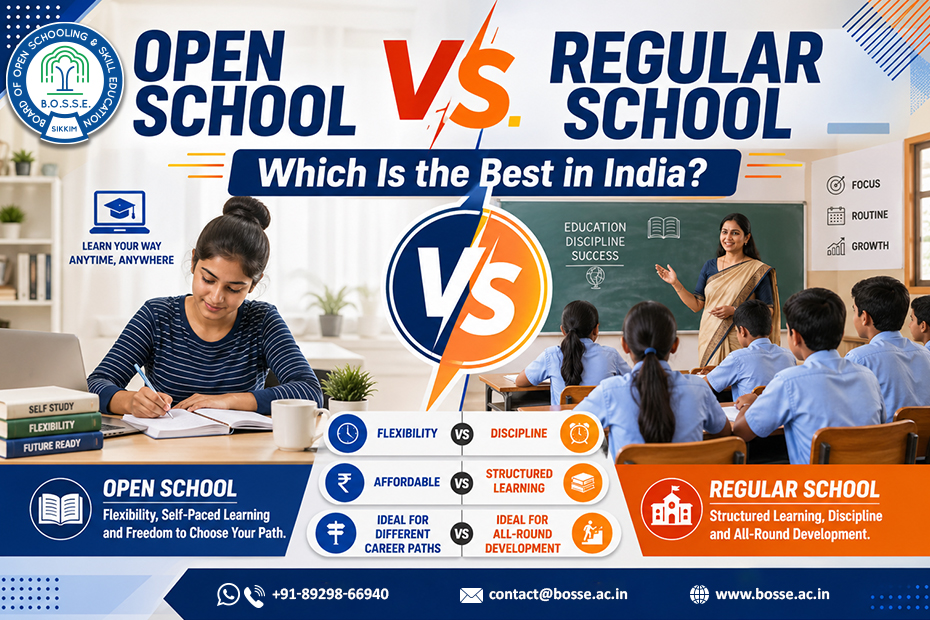
Open School vs. Regular School: Which Is the Best in India?
open school admission in India
Introduction
In the modern era, there is no restriction for students to follow only one educational format in India. In the past, the students used to go through the standard school curriculum, but now the scope of an open school is rising. The changing lifestyle, competition, and personal struggles have forced people to provide diverse opportunities for education.
The current trends suggest that more and more students are considering open schooling. In several Indian states, there is an increase in the number of students in open schooling systems by more than 100%. Meanwhile, the importance of standard schooling cannot be undermined, as it facilitates structure, discipline, and social interaction.
Psychologically, every individual has his/her own way of studying. While some students are suitable for the regular schooling environment, others might benefit from open schooling environments. Therefore, it is essential to know about the differences between open school, open school board, UP open school and regular school before making a decision.
In this article, you will find out what makes open schooling different from traditional schooling, and you will know what kind of schooling will suit you if you are a dropout student and you want to once again begin your educational career through open schooling. At present, the best open school in India is none other than BOSSE, which provides quality education within the reach of all, according to the requirements and interests of students.
What is an Open School?
Open schooling is an adaptive form of education wherein the student is not required to be physically present in the classroom every day. They have the liberty of studying from the comfort of their homes, planning their schedules, and preparing themselves for examinations.
Such boards as BOSSE organize examinations and certify the students on par with other boards. The purpose of open schooling is to cater to those students who find it impossible to pursue conventional education for some personal, economical, or academic reason. Open schooling will also help the students to prepare for competitive examinations along with their studies.
Research in education psychology indicates that the self-learning process will enhance the student’s comprehension and retention capability up to 60%, provided they are consistent and disciplined.
What is a Regular School?
On the other hand, regular education involves a system whereby learners attend classes every day, adhere to timetables, and undertake examinations on set dates. The teachers supervise the learners all through, and education takes place in classrooms.
Such a system enables learners to become disciplined, enhance their communication skills, and foster teamwork. Based on psychological research, learners who undertake their education in normal settings may be consistent owing to the fact that they have a routine and constant supervision. Regular schools suit learners who require supervision and those who benefit much in group activities.
Flexibility vs. Structure: The Core Difference
The most significant distinction between open school and regular school is the flexibility of the latter. Students in an open school have the freedom to choose the time and amount of study hours. On the contrary, the latter follows a specific timetable.
Psychologically, flexibility encourages decision-making and autonomy. Nevertheless, studies indicate that flexible systems favor self-motivated students. The rest find it challenging to excel without external motivation. Structured systems eliminate decision-making fatigue, which is why normal schools are suitable for disciplined students.
Learning Style and Academic Performance
For an open school, learners rely more on studying individually, online sources, and little guidance. In contrast, regular schools have learning guided directly by teachers through face-to-face interactions and feedback sessions.
Active learning and reviewing information on one’s own can increase retention by 70%, but only if one focuses well and makes good plans. Otherwise, learners in open schools can be disadvantaged due to lack of discipline.
The advantage of learners in regular schools is that they revise daily, get clarifications from teachers, and discuss among peers to keep improving constantly.
Exam Pressure and Mental Health
The most significant benefit of the open school system is that students face less exam stress. The freedom of deciding when one wants to take an exam eliminates stress.
Psychologists have found out that students who have a degree of autonomy in their studies and exam schedule perform better without feeling anxious. But sometimes this may cause them to procrastinate.
In traditional schools, there is pressure due to the fixed schedule for exams, but this helps students maintain consistency.
Open School Admission vs. Regular School Admission
The procedure of getting into open schools is simple and easy. It is easy to apply without having any cutoffs or entrance examinations.
However, in case of regular schools, it can be more complicated. This may prove to be problematic for those who have missed out on some portions of their education.
This factor contributes the most to making open schooling a sought-after phenomenon in recent times.
Cost and Accessibility of Education
Education under an open school system is relatively cheaper than the education provided in traditional schools, particularly private schools. Thus, the open system can be seen as a viable choice for students who belong to economically disadvantaged families.
According to research, one of the leading causes of school dropout among Indian youths is the heavy cost of education.
What is UP Open School?
“UP open school” means an open schooling system that is accessible to students of Uttar Pradesh. The majority of students of this state come across various problems such as financial problems, academic problems, or other personal problems.
The drop-out percentage among students of Uttar Pradesh has become around 2–3% in secondary schools. However, there is a vast number of students who require flexible study facilities in order to proceed with education.
Why Open School is Growing in India
There is an increase in open schooling since it addresses genuine issues. Students drop out of school owing to failure, pressure, or insufficient resources. Open school provides an additional chance for such students to continue with their education.
New statistics indicate that there have been substantial increases in the number of students enrolling in open schooling, even exceeding 120% in some areas. This is clear proof that students are now inclined toward open schooling.
The other critical factor is flexibility. Present-day students need to be able to balance education with employment or preparation for competitive exams.
Challenges of Open School
There are various challenges associated with open schooling despite its benefits. The main challenge is poor discipline. When there are no lessons for the learners to attend on a daily basis, their concentration is compromised.
It has been reported that in some instances, 70% of open schooling candidates have failed the examinations because they were not adequately prepared.
The reason behind this is psychological since learners depend a lot on self-motivation. The problem arises when there is no specific aim or schedule.
Psychological Insight: Which System is Better?
It is not easy to provide a definite response here since it depends a great deal on the particular characteristics of each learner.
If the learner is a self-starter and motivated from within, then he or she is likely to do well in an open school.
However, for learners who require a structure or external motivation to do well, regular schools are more suitable.
Why Choose BOSSE Open School Board?
The Board of Open Schooling and Skill Education (BOSSE) has become a popular choice among many students requiring flexible access to education programs. This board caters to those students who do not fit within the traditional framework of education due to several constraints such as personal, financial, professional, or geographical factors. This board offers certification services that are eligible for admission to higher studies as well as other jobs.
One benefit of this BOSSE board lies in its relatively simple admission procedure and fees structure. This makes admission possible for those students who cannot afford complex admission processes and high fees of conventional institutions. Another reason why it is more preferred by many students is that the board provides both theoretical and practical skills along with academic qualifications.
It is a balanced mode that makes it relevant to learners from all backgrounds, ranging from employed people, dropouts, housewives, and even those living in rural areas. Being flexible, affordable, and accessible, BOSSE has managed to adapt to the requirements of modern learners, ensuring that they achieve their educational and professional goals.
Conclusion
To sum up, both systems of education have their importance. Discipline and structure of learning are offered by regular schools, whereas flexibility and opportunities to learn without any constraints are available in open schools.
The rising trend in open schools in India signifies that the learners of this era need something new and different. The boards such as BOSSE are contributing towards bridging the gap with the help of practical approaches.
Ultimately, the choice will be made according to one’s own mindset, aim, and discipline. Education should never be seen as a one-track journey, but the learner should choose the track that can take him to success.
Take the first step toward your future today by choosing the path that matches your dreams and potential. Explore your options, believe in your abilities, and commit yourself to continuous learning. The right decision made today can open doors to new opportunities, growth, and long-term success tomorrow.